Global Barware Market Growth, Trends and Outlook

Global Barware Market Growth, Size, Trends Analysis- By Product Type, By Material, By Price, By End Use, By Distribution Channel – Regional Outlook, Competitive Strategies and Segment Forecast to 2034

Published: Jan-2026 Report ID: FMCG2602 Pages: 1 - 249 Formats*:     
Category : Consumer & Retail
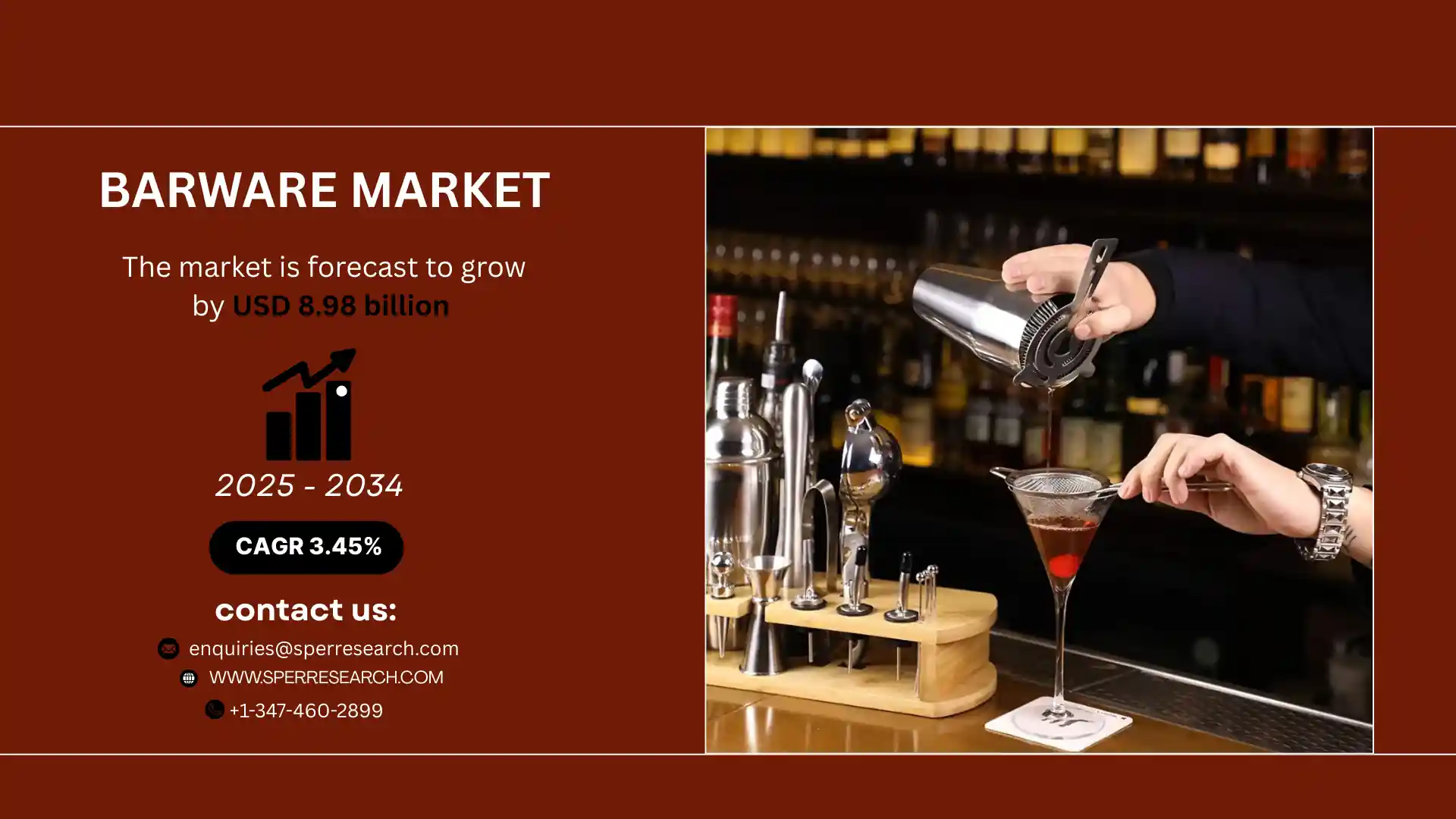
According to SPER Market Research, the Global Barware Market is estimated to reach USD 8.98 billion by 2034 with a CAGR 3.45%.

Introduction and Overview
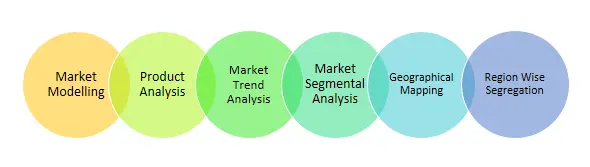
The report includes an in-depth analysis of the Global Barware Market, including market size and trends, product mix, Applications, and supplier analysis.

The global Barware Market was valued at USD 6.4 billion in 2024 and is expected to grow at a CAGR of approximately 3.45% from 2025 to 2034. The market is expanding due to rising demand for premiumization along with continuous material innovation, which encourages the creation of durable, stylish, and high-quality products. Increasing disposable incomes coupled with the growing popularity of home bars are further supporting market growth by motivating consumers to invest in premium barware for residential and commercial use. The expanding hospitality sector and ecommerce channels are also enhancing accessibility and adoption. These trends collectively underscore a shift toward sophisticated barware products that elevate beverage presentation and overall drinking experiences.

By Product Type: 
By product type, glassware represents the largest contribution to overall barware revenues. Items such as whiskey glasses, tumblers, wine glasses, and cocktail glasses are essential across both residential and commercial environments, leading to consistent demand. These products are frequently replaced and purchased in sets, supporting higher sales volumes. Their role in enhancing beverage presentation and drinking experience further strengthens consumer preference. Other product categories, including shakers, strainers, and bar tools, contribute steadily but account for a smaller portion of overall value compared with core drinkware products that are universally required in bars and homes.

By Material: 
In terms of material, glass accounts for the greatest share of barware sales due to its clarity, versatility, and aesthetic appeal. Consumers and hospitality operators favor glass as it highlights beverage color and presentation, making it suitable for both casual and premium use. Glass products are widely available across different price ranges, supporting broad adoption. Crystal, metal, and plastic materials serve niche or specific use cases, such as luxury dining or outdoor settings. However, the widespread acceptance, functional advantages, and visual appeal of glass position it as the most widely used material segment.

By Price: 
By price, the medium-priced segment attracts the highest level of demand within the barware market. This segment appeals to a broad consumer base by offering a balance between design quality, durability, and affordability. Medium-priced products are popular among households upgrading home bars as well as commercial buyers seeking cost-effective yet stylish solutions. Low-priced barware is commonly chosen for basic utility or high-volume use, while high-priced items cater to luxury consumers and premium hospitality venues. Wider accessibility and value-for-money positioning make the mid-range segment the most preferred across regions.

By End Use: 
By end use, commercial applications account for a larger share of barware consumption compared with residential use. Bars, restaurants, hotels, lounges, and catering services require consistent purchases of durable and visually appealing barware to support daily operations and customer experience. High turnover rates, breakage, and the need for uniform presentation drive recurring demand from commercial establishments. Residential use continues to grow due to home entertaining trends, but purchase frequency remains lower. Continuous demand from hospitality venues places commercial end use in a stronger position within overall market consumption.

By Distribution Channel: 
By distribution channel, offline sales generate a higher share of barware revenue than online platforms. Specialty stores, department stores, supermarkets, and hospitality suppliers remain preferred purchasing points, allowing buyers to assess product quality, weight, and design in person. This is especially important for fragile glassware and premium items. Offline channels also benefit from established supplier relationships with commercial buyers. Online channels are expanding rapidly due to convenience and wider selection, but physical retail continues to account for a larger portion of sales due to trust, immediate availability, and hands-on evaluation.

Regional Insights: 
North America represents a major share of the global barware market, supported by strong consumer spending, a well-established hospitality industry, and the growing trend of home bars across the U.S. and Canada. Europe also contributes significantly, with countries such as the UK, Germany, France, Italy, Spain, and Russia benefiting from rich dining cultures and premium glassware demand. Asia Pacific is witnessing steady growth, driven by rising disposable incomes and expanding hospitality sectors in China, India, Japan, South Korea, and Australia. Latin America, led by Brazil and Mexico, shows moderate expansion. The Middle East and Africa, including the UAE, Saudi Arabia, and South Africa, are emerging markets supported by luxury hospitality and tourism growth.

Market Competitive Landscape:
The Barware Market is highly consolidated. Some of the market key players are Anchor Hocking, Baccarat, Bormioli Rocco, Crystal Bohemia, Dartington Crystal, Lalique, Lladro, Lucaris, Orrefors, Ravenscroft Crystal, Riedel, Saint-Louis, Schott Zwiesel, Swarovski, Waterford

Recent Developments:
  • In December 2025, Baccarat has entered India formerly again with the induction of a flagship in Delhi’s boardwalk The Chanakya, casing luxury brands similar as Dior and Rolex in its demesne. Renowned for casting true masterpieces, the luxury crystalware maison continues to inspire dilettantes of luxury, embracing beauty, contemporary refinement, and unique gests.
  • In October 2024, Waterford launches barware, mates with Visual Comfort in lighting. Waterford is offering select patterns of barware from its Heritage Mastercraft multifariousness in sets of two. Alana, Rossmore, Eileen and Lismore all patterns from either the 1950s or ‘60s are part of the launch. The patterns will also be available in small accentuation plates and elect pieces of décor.
  • In September 2023, Riedel launches new glass designed for English sparkling wine. Riedel designs wine dinnerware with a sharp focus on shape and design to bring out the flavor and aroma of each grape variety.
  • In June 2024, Zwiesel Glas expands retail presence in India through strategic cooperation with OMA Living. Feting the growing purchasing power and an systematized retail sector, Zwiesel has decided to introduce its Tritan demitasse spectacles to Indian retailers.
  • In May 2023, India's leading omnichannel retailer for decoration, transnational kitchen and homeware, thin Kitchen has blazoned the launch of Anchor Hocking. With Anchor Hocking's new advents, thin Kitchen’s Barware range boasts of further choices in beer, whiskey, wine, and champagne spectacles, among others. In addition, the thin Kitchen Storage range is extended to glass easy- to- view storehouse perfect for the association and transport of food fix particulars and leavings.
Scope of the report:
Report MetricDetails
Market size available for years2021-2034
Base year considered2024
Forecast period2025-2034
Segments coveredBy Product Type, By Material, By Price, By End Use, By Distribution Channel
Regions coveredNorth America, Latin America, Asia-Pacific, Europe, and Middle East & Africa
Companies CoveredAnchor Hocking, Baccarat, Bormioli Rocco, Crystal Bohemia, Dartington Crystal, Lalique, Lladro, Lucaris, Orrefors, Ravenscroft Crystal, Riedel, Saint-Louis, Schott Zwiesel, Swarovski, Waterford

Key Topics Covered in the Report
  • Global Barware Market Size (FY’2021-FY’2034)
  • Overview of Global Barware Market
  • Segmentation of Global Barware Market by Product Type (Glasses, Decanters, Pitchers, Shaker, Others)
  • Segmentation of Global Barware Market by Material (Glass, Metal, Plastic, Crystal, Others)
  • Segmentation of Global Barware Market by Price (Low, Medium, High)
  • Segmentation of Global Barware Market by End Use (Residential, Commercial)
  • Segmentation of Global Barware Market by Distribution Channel (Online, Offline)
  • Statistical Snap of Global Barware Market
  • Expansion Analysis of Global Barware Market
  • Problems and Obstacles in Global Barware Market
  • Competitive Landscape in the Global Barware Market
  • Details on Current Investment in Global Barware Market
  • Competitive Analysis of Global Barware Market
  • Prominent Players in the Global Barware Market
  • SWOT Analysis of Global Barware Market
  • Global Barware Market Future Outlook and Projections (FY’2025-FY’2034)
  • Recommendations from Analyst


1.Introduction
1.1.Scope of the report
1.2.Market segment analysis 

2.Research Methodology
2.1.Research data source
2.1.1.Secondary Data
2.1.2.Primary Data
2.1.3.SPER’s internal database
2.1.4.Premium insight from KOL’s
2.2.Market size estimation
2.2.1.Top-down and Bottom-up approach
2.3.Data triangulation

3.Executive Summary

4.Market Dynamics
4.1.Driver, Restraint, Opportunity and Challenges analysis
4.1.1.Drivers
4.1.2.Restraints
4.1.3.Opportunities
4.1.4.Challenges

5.Market variable and outlook
5.1.SWOT Analysis
5.1.1.Strengths
5.1.2.Weaknesses
5.1.3.Opportunities
5.1.4.Threats
5.2.PESTEL Analysis
5.2.1.Political Landscape
5.2.2.Economic Landscape
5.2.3.Social Landscape
5.2.4.Technological Landscape
5.2.5.Environmental Landscape
5.2.6.Legal Landscape
5.3.PORTER’s Five Forces 
5.3.1.Bargaining power of suppliers
5.3.2.Bargaining power of buyers
5.3.3.Threat of Substitute
5.3.4.Threat of new entrant
5.3.5.Competitive rivalry
5.4.Heat Map Analysis

6.Competitive Landscape
6.1.Global Barware Market Manufacturing Base Distribution, Sales Area, Product Type 
6.2.Mergers & Acquisitions, Partnerships, Product Launch, and Collaboration in Global Barware Market

7.Global Barware Market, By Product Type, (USD Million) 2021-2034 
7.1.Glasses
7.1.1.Whiskey glasses
7.1.2.Tumblers
7.1.3.Cocktail glasses
7.1.4.Others (shot glasses etc.)
7.2.Decanters
7.3.Pitchers
7.4.Shaker
7.5.Others (bar accessories etc.)

8.Global Barware Market, By Material, (USD Million) 2021-2034 
8.1.Glass
8.2.Metal
8.3.Plastic
8.4.Crystal
8.5.Others (wood etc.)

9.Global Barware Market, By Price, (USD Million) 2021-2034 
9.1.Low
9.2.Medium
9.3.High

10.Global Barware Market, By End Use, (USD Million) 2021-2034 
10.1.Residential
10.2.Commercial
10.2.1.Bars and lounges
10.2.2.Restaurants
10.2.3.Hotels
10.2.4.Others (caterers etc.)

11.Global Barware Market, By Distribution Channel, (USD Million) 2021-2034 
11.1.Online
11.1.1.E-commerce
11.1.2.Company websites
11.2.Offline
11.2.1.Supermarket/hypermarket
11.2.2.Specialty store
11.2.3.Others (department stores etc.)  

12.Global Barware Market, (USD Million) 2021-2034 
12.1.Global Barware Market Size and Market Share

13.Global Barware Market, By Region, 2021-2034 (USD Million)
13.1.Asia-Pacific
13.1.1.Australia
13.1.2.China
13.1.3.India
13.1.4.Japan
13.1.5.South Korea
13.1.6.Rest of Asia-Pacific
13.2.Europe
13.2.1.France
13.2.2.Germany
13.2.3.Italy
13.2.4.Spain
13.2.5.United Kingdom
13.2.6.Rest of Europe
13.3.Middle East and Africa
13.3.1.Kingdom of Saudi Arabia 
13.3.2.United Arab Emirates
13.3.3.Qatar
13.3.4.South Africa
13.3.5.Egypt
13.3.6.Morocco
13.3.7.Nigeria
13.3.8.Rest of Middle-East and Africa
13.4.North America
13.4.1.Canada
13.4.2.Mexico
13.4.3.United States
13.5.Latin America
13.5.1.Argentina
13.5.2.Brazil
13.5.3.Rest of Latin America 

14.Company Profile
14.1.Anchor Hocking
14.1.1.Company details
14.1.2.Financial outlook
14.1.3.Product summary 
14.1.4.Recent developments
14.2.Baccarat
14.2.1.Company details
14.2.2.Financial outlook
14.2.3.Product summary 
14.2.4.Recent developments
14.3.Bormioli Rocco
14.3.1.Company details
14.3.2.Financial outlook
14.3.3.Product summary 
14.3.4.Recent developments
14.4.Crystal Bohemia
14.4.1.Company details
14.4.2.Financial outlook
14.4.3.Product summary 
14.4.4.Recent developments
14.5.Dartington Crystal
14.5.1.Company details
14.5.2.Financial outlook
14.5.3.Product summary 
14.5.4.Recent developments
14.6.Lalique
14.6.1.Company details
14.6.2.Financial outlook
14.6.3.Product summary 
14.6.4.Recent developments
14.7.Lladro
14.7.1.Company details
14.7.2.Financial outlook
14.7.3.Product summary 
14.7.4.Recent developments
14.8.Lucaris
14.8.1.Company details
14.8.2.Financial outlook
14.8.3.Product summary 
14.8.4.Recent developments
14.9.Orrefors
14.9.1.Company details
14.9.2.Financial outlook
14.9.3.Product summary 
14.9.4.Recent developments
14.10.Ravenscroft Crystal
14.10.1.Company details
14.10.2.Financial outlook
14.10.3.Product summary 
14.10.4.Recent developments
14.11.Riedel
14.11.1.Company details
14.11.2.Financial outlook
14.11.3.Product summary 
14.11.4.Recent developments
14.12.Saint-Louis
14.12.1.Company details
14.12.2.Financial outlook
14.12.3.Product summary 
14.12.4.Recent developments
14.13.Schott Zwiesel
14.13.1.Company details
14.13.2.Financial outlook
14.13.3.Product summary 
14.13.4.Recent developments
14.14.Swarovski
14.14.1.Company details
14.14.2.Financial outlook
14.14.3.Product summary 
14.14.4.Recent developments
14.15.Waterford
14.15.1.Company details
14.15.2.Financial outlook
14.15.3.Product summary 
14.15.4.Recent developments

15. Conclusion

16. List of Abbreviations

17. Reference Links

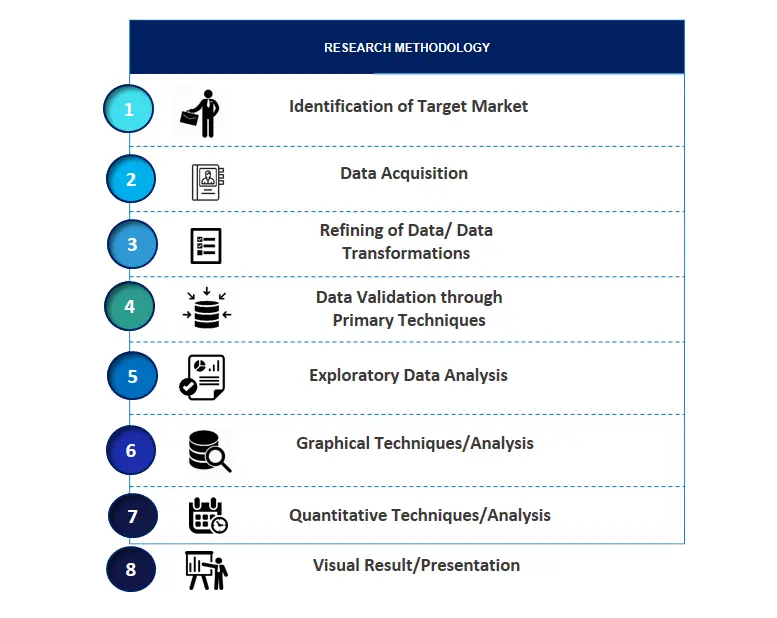
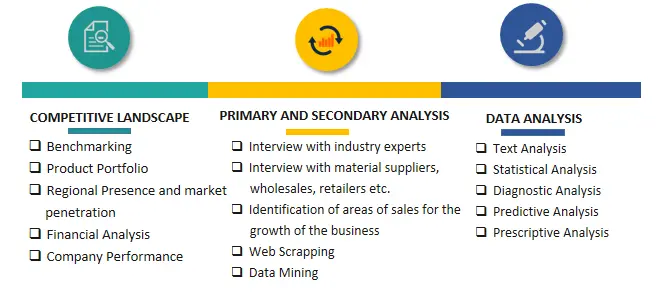
SPER Market Research’s methodology uses great emphasis on primary research to ensure that the market intelligence insights are up to date, reliable and accurate. Primary interviews are done with players involved in each phase of a supply chain to analyze the market forecasting. The secondary research method is used to help you fully understand how the future markets and the spending patterns look likes.

The report is based on in-depth qualitative and quantitative analysis of the Product Market. The quantitative analysis involves the application of various projection and sampling techniques. The qualitative analysis involves primary interviews, surveys, and vendor briefings.  The data gathered as a result of these processes are validated through experts opinion. Our research methodology entails an ideal mixture of primary and secondary initiatives.
SPER-Methodology-1

SPER-Methodology-2

SPER-Methodology-3


Frequently Asked Questions About This Report
Consumers are investing in high-quality, stylish barware to elevate beverage presentation. Premiumization is driven by rising disposable incomes, home bar culture, and demand for durable materials.
Hotels, bars, and restaurants are major buyers of premium barware. The hospitality sector’s focus on customer experience and presentation standards significantly boosts demand.
Online channels provide consumers with easy access to diverse barware collections, competitive pricing, and global brands. This has expanded adoption beyond traditional retail outlets.
PLACE AN ORDER
  • 15 % off
     
    $ 4250
  • 20 % off
             
    $ 5650
  • 25 % off
         
    $ 7450
Pre-Purchase Inquiry
SEND AN INQUIRY
NEED CUSTOMIZATION?
Request Customization
CALL OR EMAIL US
US:
India:
Email:
100% Secure Payment

SPER American Express
SPER VISA
SPER Master Card
SPER Mestro
SPER Paypal
SPER CCAvenues
Related Reports

Global Rechargeable Light Market Growth, Size, Trends Analysis-By Type, By Product Type, By Power Source, By Price, By End Use, By Distribution Channel– Regional Outlook, Competitive Strategies and Segment Forecast to 2035


Global Connected TV Market - By Screen Size, By Technology, By Screen Type, By Resolution, By End Use and By Distribution Channel - Regional Outlook, Competitive Strategies and Segment Forecast to 2034


Global Smartwatch Market - By Product Type, By Operating System, By Display Type, By Price Range, By Application, By End-use and By Distribution Channel - Regional Outlook, Competitive Strategies and Segment Forecast to 2034


Global Mouth Freshener Market Growth, Size, Trends Analysis- By Product Type, By Category, By Ingredient, By Price Range, By Distribution Channel – Regional Outlook, Competitive Strategies and Segment Forecast to 2034


Canada Air Purifier Market Growth, Size, Trends Analysis-By Technology, By Product Type, By Coverage Area, By Price Range, By End User, By Distribution Channel Regional Outlook, Competitive Strategies and Segment Forecast to 2034


Europe Pet Coat Care Market Growth, Size, Trends Analysis- By Product, By Size, By Delivery, By Type/Ingredient, By Pet Type, By End Use, By Distribution Channel – Regional Outlook, Competitive Strategies and Segment Forecast to 2034


Global Equestrian Equipment Market Growth, Size, Trends Analysis- By Equipment Type, By Price, By Gender, By Consumer Group, By Distribution Channel – Regional Outlook, Competitive Strategies and Segment Forecast to 2034


Have a glance of the Report

  Download Free Sample

Looking for Customization?

 Customization Request

Have a Question?

 Reach Our Analysis Team

COVID-19 impact analysis?

 Request Analysis
Thought Leadership

Trusted by Industry Leaders

Our data-driven insights have influenced the strategy of 200+ reputed companies across the globe.

SPER-Astellas Pharma
SPER-Microsoft
SPER-EY
SPER-McKinsey
SPER-Bain
SPER-Max-Healthcare
SPER-DHL
SPER-IQVIA
SPER-Mitsubishi Logistics
SPER-PACCOR
SPER-Macmillan Education
SPER-Kankar IMRB
SPER-ITA
SPER-PWC
SPER-SAPTCA
SPER-Straumann
SPER-Danaher
SPER-AandM
SPER-MENARINI Silicon Biosystems
SPER-IPSOS
SPER-Heineken
HIPPA Compliant
GDPR Certified
ISO 27001
Peer Reviewed
Get Started Today

Your Competitive Advantage in
Pharmaceutical & Medical Technology
Markets

Join industry leaders leveraging AI-powered intelligence to make confident, data-driven decisions that accelerate breakthrough treatments and technologies to market.

No Credit Card Required
15-Minute Demo
Expert Guidance